
Shifting load? Two simple solutions for better grip on the fork
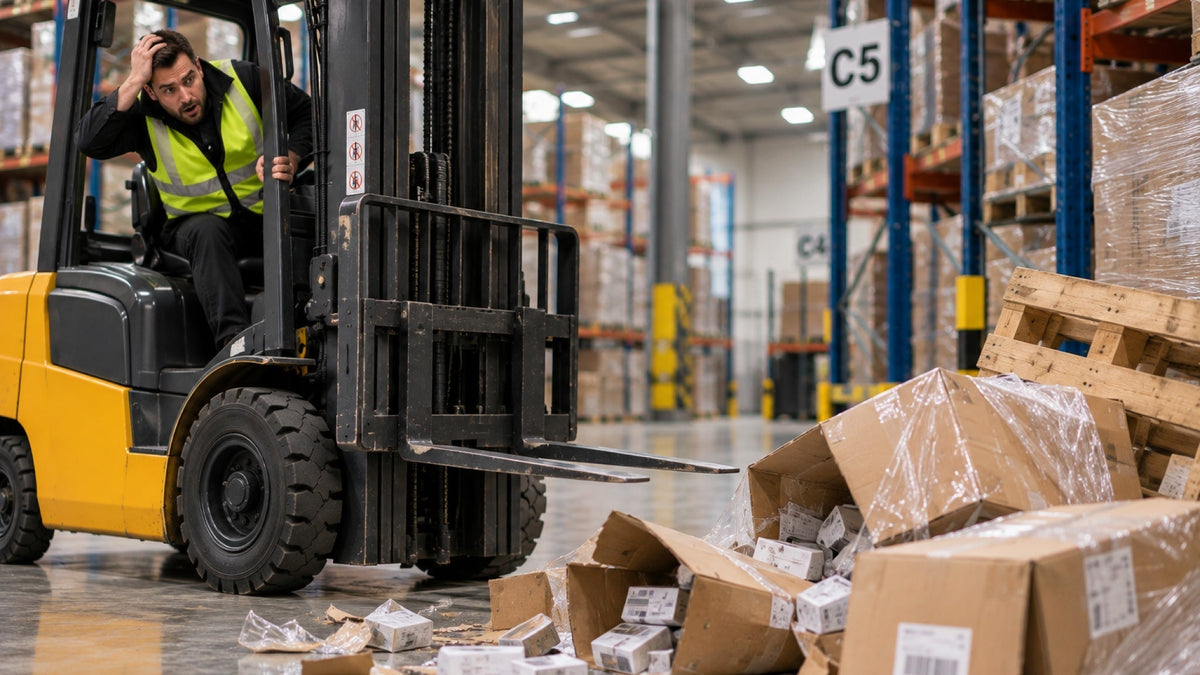
The pallet has been picked up cleanly, the load is sitting securely on the forks, and the forklift starts moving. But while braking, accelerating, or taking the next corner, the load suddenly begins to slip. In the worst-case scenario, the load falls completely off the forks. The consequences can include damaged goods and interrupted workflows, as well as an increased risk of accidents for people, vehicles, and facilities in the immediate work area.
But why does a load slide off the forks in the first place? And how can this be prevented with simple means?
Why does a load slide off forklift forks?
Forklift forks are made of steel. That is precisely what can become a problem during transport: there is often very little friction between the smooth steel surface and pallets or other transported goods.
Examples of goods particularly at risk of slipping include:
- shrink-wrapped pallets
- plastic pallets
- metal parts
- wooden boards
- smooth or delicate transported goods
- damp load carriers
As long as the forklift is stationary, the lack of grip is often not even noticeable. It is only when movement or uneven surfaces come into play that it can become dangerous.
Which situations cause a load to slip?
Often, it does not take an extreme driving situation. Even everyday movements can be enough:
- starting off and accelerating
- braking
- cornering
- uneven ground
- lifting and setting down the load
- vibrations during transport
The problem is therefore not necessarily due to a driving error. Even with cautious driving, the low friction between the fork and the load remains.
The crucial question is therefore: How can the grip between the fork and the load be increased?
The solution: Anti-slip protection directly on the fork
A simple option is to start exactly where the slipping occurs: at the contact surface between the fork and the load.
An anti-slip surface increases friction and thus improves the stability of the transported goods.
But which solution makes sense? That depends primarily on how often increased slip resistance is required.

GEKKO: Anti-slip layer for occasional use
Those who only occasionally transport loads that are prone to slipping or are delicate do not necessarily need a permanent solution.
The GEKKO anti-slip cover for forks is suitable here.
The magnetic anti-slip layer is attached directly to the fork blade when needed. Thanks to the integrated magnets, it can be installed quickly and removed again after use.
The advantages:
- flexible to use
- increased slip resistance
- protection for delicate surfaces
- ideal for changing transport tasks

CROC fork coating: Permanent slip resistance for forks
But what if loads prone to slipping are transported daily?
Then forks with the CROC fork coating are the more suitable solution.
Unlike a removable anti-slip cover, the CROC coating is permanently bonded to the forks.
This means:
- permanently increased slip resistance
- no additional setup times
- ready for use at any time
- integrated impact edge protection
Especially for regular transport tasks, a permanent coating can simplify workflows while simultaneously ensuring more safety.
Conclusion: Occasional or permanent slip resistance?
More grip on the fork does not have to be complicated. Which solution fits best depends on the respective application.
For occasional use, GEKKO offers a flexible and quickly mountable solution. Those who require more slip resistance on a permanent basis can opt for a lasting solution with the CROC fork coating.


Leave a comment
This site is protected by hCaptcha and the hCaptcha Privacy Policy and Terms of Service apply.