
Operating Forklifts Safely: The Most Important Requirements of German DGUV
The use of forklifts in Germany is subject to clear occupational safety and traffic regulations. The primary governing regulations are the German DGUV Regulation 68 “Industrial Trucks,” supplemented by the Industrial Safety Ordinance (BetrSichV) and—when operating in public traffic areas—the Road Traffic Licensing Regulations (StVZO).
It is crucial for companies to note: As soon as forklifts are used for more than just internal operations, additional obligations apply.
Key DGUV Requirements for the Use of Forklifts
DGUV Regulation 68 requires employers to comply with the following points, among others:
1. Authorization and Qualification of Operators
Forklifts may only be operated by persons who:
- are at least 18 years old
- are technically qualified and have received appropriate training
- have been formally authorized in writing by the employer
This requirement is directly stipulated in Section 7 of DGUV Regulation 68.
2. Safe condition and intended use
Employers must ensure that industrial trucks:
- are safe to operate
- are inspected regularly
- are used only in accordance with their design and intended purpose
These obligations arise from Sections 3, 9, and 12 of DGUV Regulation 68 and from Section 14 of the BetrSichV.
Forklifts in Public Traffic Areas: Additional Obligations
As soon as a forklift operates in a public traffic area, the Road Traffic Regulations (StVO) and the Road Traffic Licensing Regulations (StVZO) apply in addition to occupational safety laws.
It is important to note:
A public traffic area does not necessarily have to be public property. The sole determining factor is whether an area is actually accessible to an indefinite or large group of people.
When a company premises is considered a public thoroughfare
A company premises is legally considered a public thoroughfare if:
- it is not effectively cordoned off
- third-party vehicles such as trucks, freight carriers, or customers operate there
- access is tacitly or explicitly permitted
Occupational safety associations expressly point out that in such cases, the Road Traffic Regulations (StVO) and the Road Traffic Licensing Regulations (StVZO) apply—regardless of ownership.
Covering of Forks According to German StVZO § 30c (in conjunction with § 32)
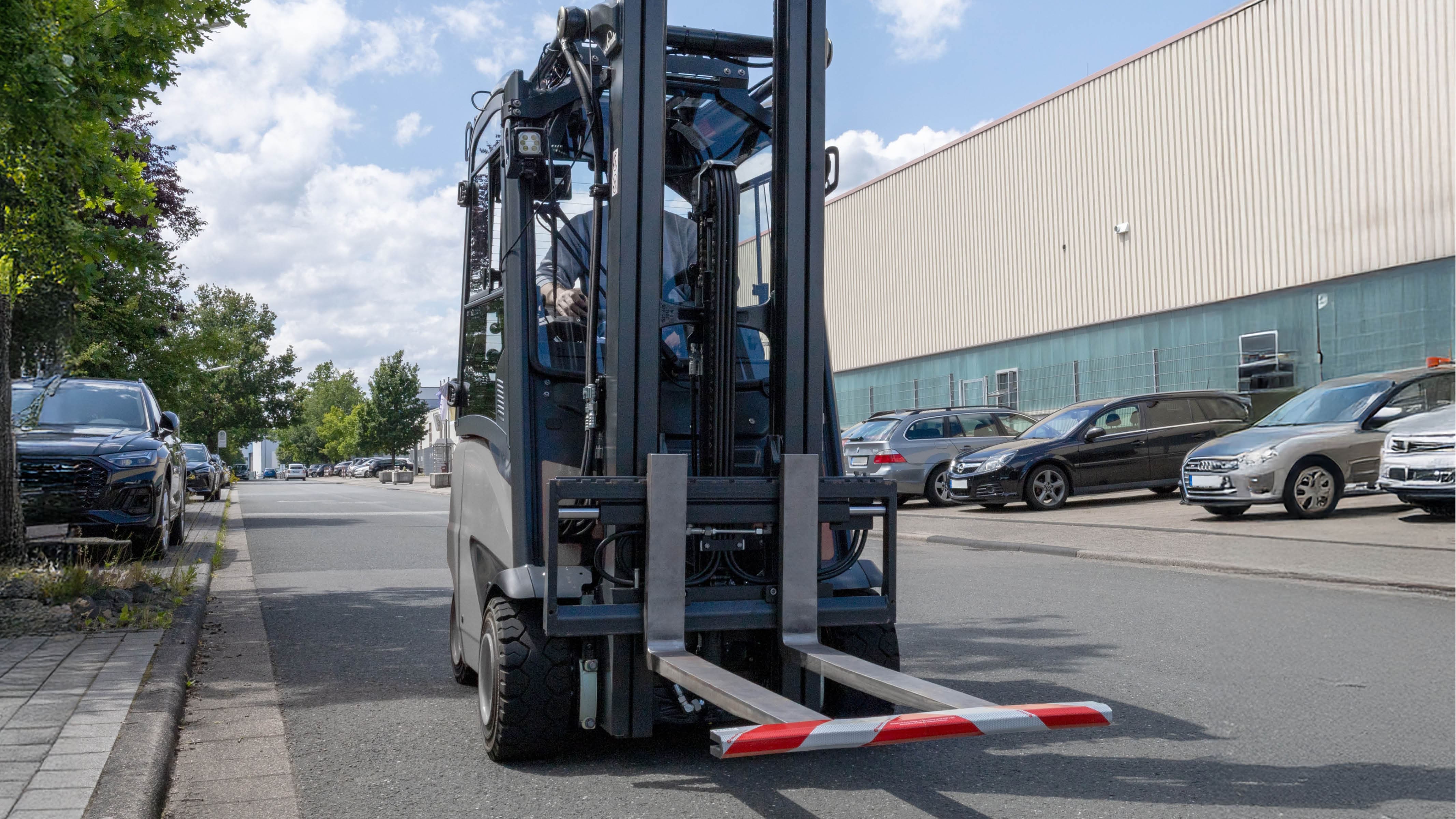
If forklifts are moved empty in public traffic areas, the tips of the forks must be covered or secured. This requirement derives from the general hazard prohibitions of the German StVZO and is standard administrative practice of the professional associations.
Specialist agencies and professional association publications clarify:
- Unprotected forks pose a significant danger to other road users
- Covers serve to prevent the risk of injury and collisions
Implications for Businesses
In practical terms, this means the following for businesses:
- Forklift operations in open, accessible yards, loading docks, or access roads are subject to traffic laws
- The absence of covers or safety measures may have implications for liability and insurance
- Private company premises do not automatically exempt businesses from StVZO obligations
The German BG RCI expressly recommends adapting equipment, organization, and risk assessments in such cases.
In the CleverForks online shop, you’ll find the ZEBRA warning bar for this application. It slides magnetically onto the forks and is thus mounted and ready for use in no time. When not in use, the warning bar can be attached to the outside of the forklift using additional magnets and is always ready for use.
Conclusion
The DGUV requires more than just training and inspections for forklift operations.
As soon as industrial trucks enter areas considered public traffic spaces, additional legal requirements apply—particularly regarding the safety of protruding vehicle parts such as forks.
Companies that take these considerations into account early on not only reduce the risk of accidents but also minimize legal uncertainties in daily operations.

Leave a comment
This site is protected by hCaptcha and the hCaptcha Privacy Policy and Terms of Service apply.