
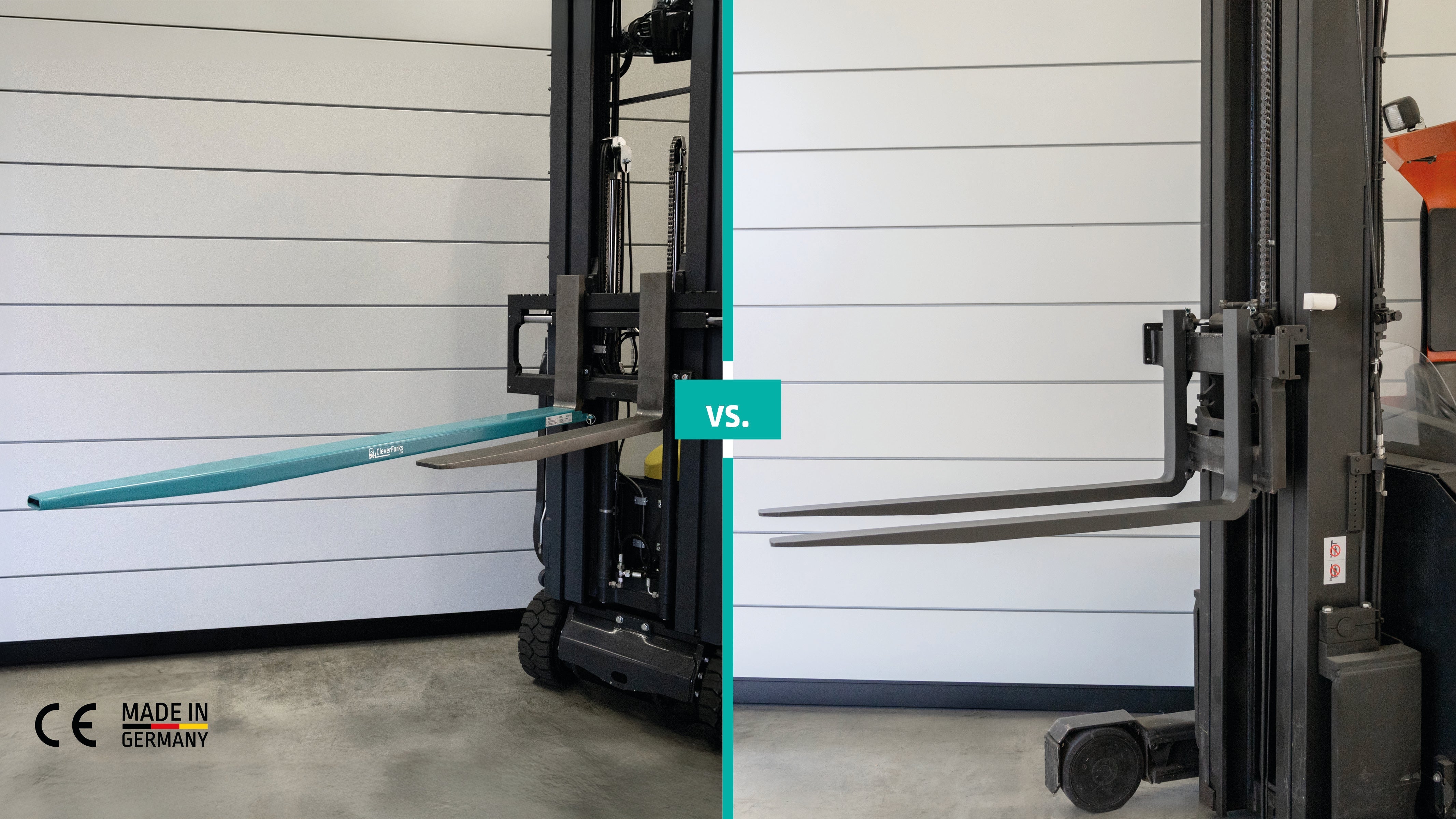
Fork extensions or longer forks—which is better?
If a forklift’s existing forks are too short for a particular load, there are essentially two options: using fork extensions or installing longer forks. Both solutions increase the usable fork length—but differ significantly in terms of flexibility, cost, and application.
Which option is better therefore depends primarily on how often long loads are transported and the specific requirements of the application.
What is a fork extension?
A fork extension is slid onto the existing forks and securely fastened. This allows the fork length to be increased with minimal effort.
The biggest advantage lies in flexibility: If longer forks are needed only occasionally, the extensions can be installed as needed and then removed again.
Typical applications include, for example:
- particularly large pallets
- long or bulky goods
- varying load sizes
- seasonal or occasional transports
Fork extensions are therefore particularly useful for businesses that handle loads of varying dimensions.
What are longer forks?
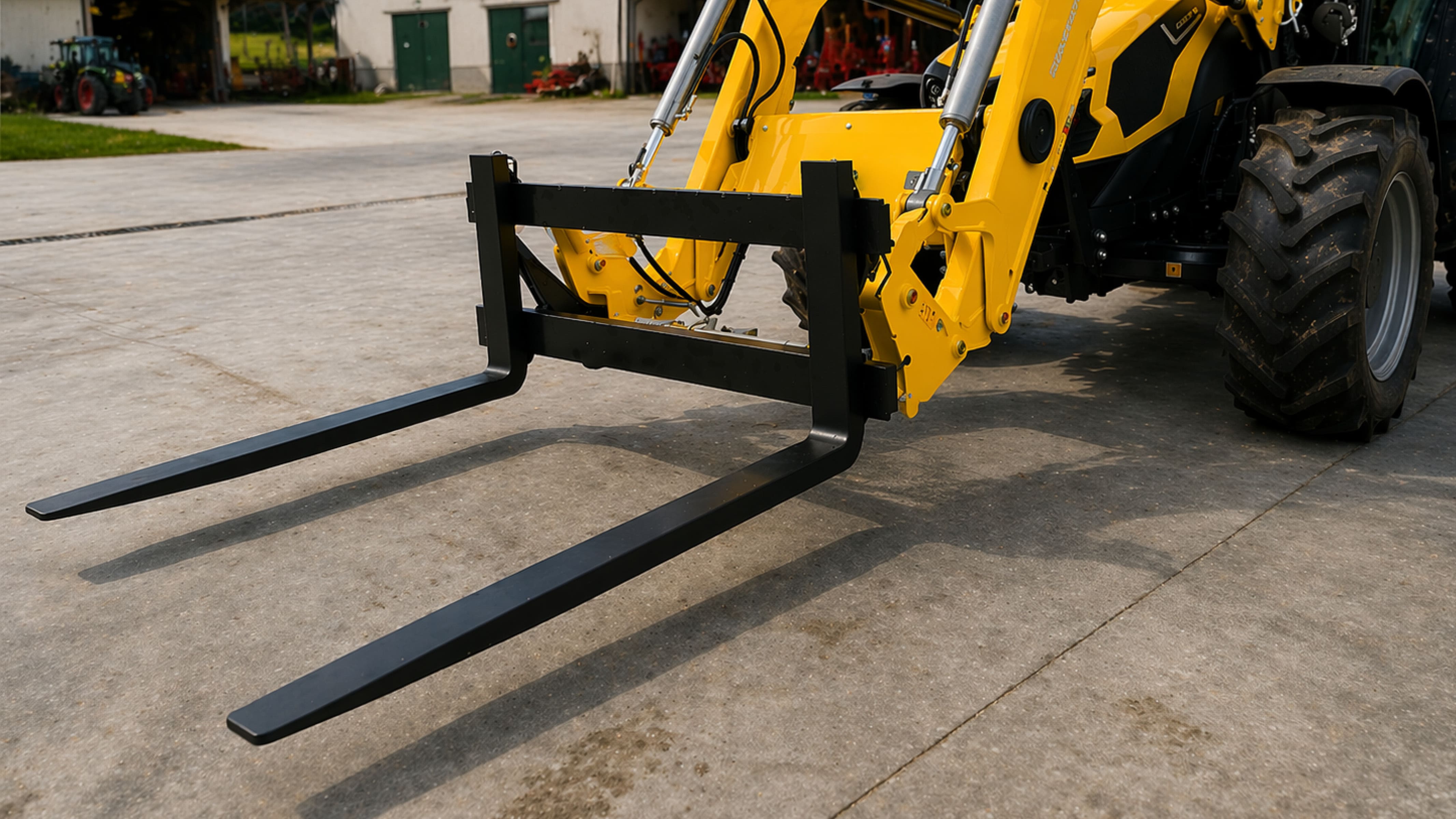
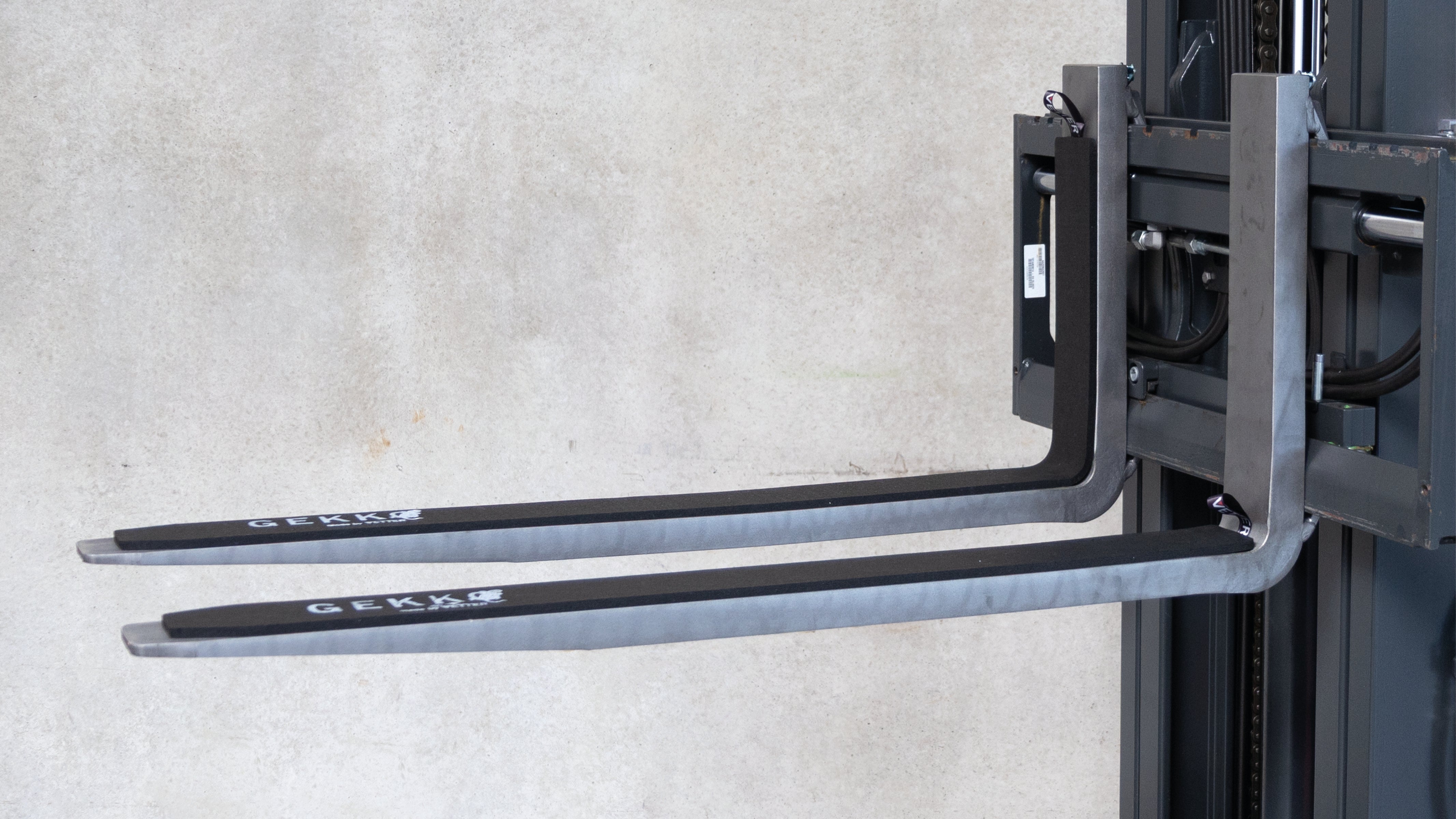
With this option, the existing forks are replaced with longer models. The required length is thus permanently available.
This is particularly useful when regularly transporting loads for which the existing forks are too short. Unlike a fork extension, no additional components need to be installed or removed.
Longer forks are therefore often the better choice for recurring and standardized transport tasks.
Fork extensions vs. longer forks: a direct comparison
1. Flexibility
Fork extensions offer a clear advantage when requirements change frequently. The forklift can continue to be used with its standard forks and can be converted to handle longer loads as needed.
Longer forks, on the other hand, are permanently mounted. This is practical when the additional length is needed regularly, but it can limit maneuverability when handling smaller loads or in tight spaces.
Advantage: Fork extension
2. Frequency of Use
If you only transport long loads occasionally, you do not necessarily need permanently longer forks. In this case, a fork extension is often the more economical solution.
On the other hand, if you work with long load carriers or large goods on a daily basis, you will usually benefit from appropriately sized, longer forks.
Occasional use: Fork extension
Regular use: longer forks
3. Purchase Costs
Fork extensions can be a cost-effective way to expand the capabilities of an existing forklift without having to purchase an additional set of forks outright.
However, the decision should not depend solely on the purchase price. Frequency of use, handling, and operational processes are also crucial factors.
4. Handling in Day-to-Day Operations
Fork extensions must be installed as needed, properly secured, and removed again after use. This takes time and requires proper handling.
Longer forks, on the other hand, are ready for immediate use. For frequently recurring transport tasks, this can simplify workflows.
Advantage for frequent use: longer forks
When is a fork extension the better choice?
A fork extension is particularly suitable when:
- longer forks are needed only occasionally,
- different load sizes are transported,
- the forklift needs to remain versatile,
- a solution that can be quickly retrofitted is sought.
A typical example is a business that primarily transports Euro pallets but occasionally needs to move larger or longer load carriers. For these applications, fork extensions can be a practical solution.
When are longer forks the better choice?
Longer forks are particularly useful when:
- long loads are transported regularly,
- the required fork length is fixed on a permanent basis,
- frequent installation and removal should be avoided,
- the forklift is used primarily for a specific purpose.
For standardized workflows with consistent load dimensions, properly sized forks are often the more convenient long-term solution.
Important: The right length alone is not enough
Regardless of whether fork extensions or longer forks are used, the components must be compatible with the forklift, the existing forks, and the intended application.
Factors to consider include:
- Dimensions of the existing forks
- Required length
- Load dimensions
- Weight and load center of gravity
- Forklift load capacity
- Manufacturer’s specifications
- Secure fastening of the components used
A change in load handling can alter the conditions for safe forklift operation. Therefore, you should always verify before use whether the chosen solution is suitable for the specific application.
Conclusion: Flexibility or a permanent solution?
There is no one-size-fits-all answer to the question, “Fork extensions or longer forks?”
Fork extensions are particularly flexible and are suitable for occasional use with longer or bulky loads. They allow an existing forklift to be quickly adapted to different transport tasks as needed.
Longer forks, on the other hand, are often the better solution for regular or long-term use. They are always available and eliminate the need to repeatedly install and remove extensions.
A simple rule of thumb is:
Occasionally need more length? → Fork extension.
Need more length on a regular basis? → Longer forks
The right solution ultimately depends on the load, frequency of use, and operational requirements. By considering these factors, you can select the appropriate option for safe and efficient material handling.
You can find suitable fork extensions in the CleverForks online shop:


Leave a comment
This site is protected by hCaptcha and the hCaptcha Privacy Policy and Terms of Service apply.