
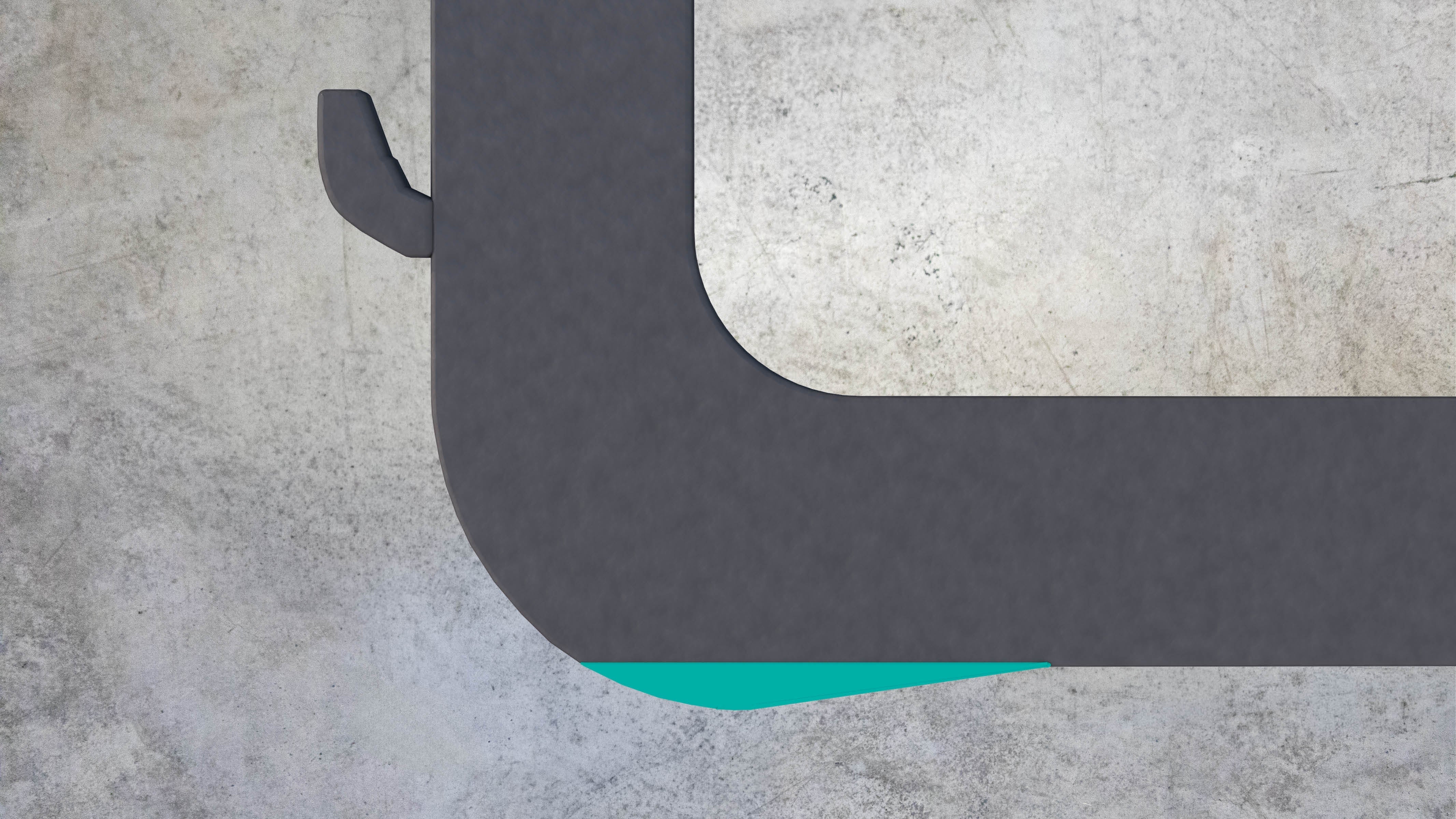
Forks with reinforced wear zone: Up to three times longer service life in daily use
Forks are among the most heavily stressed components on forklifts, front loaders, and other industrial trucks. Enormous forces are generated, especially during daily use in industry, agriculture, or on construction sites—particularly in the sensitive area where the fork bends. This is exactly where the innovative OptimaHeel comes into play.
With an additional wear zone and significantly higher load capacity, our high-quality ISO forks ensure a much longer service life and lower operating costs.
Why do forks wear out, especially at the fork bend?
The fork bend is the most heavily loaded part of a fork. High tensile and compressive forces act there during every lifting operation. Conventional forks usually have only a small wear reserve of about 4 mm in this area.
The result:
- faster material wear
- greater deflection under load
- premature replacement of the forks
- rising maintenance and spare part costs
This can significantly impact cost-effectiveness, especially during intensive use.
The OptimaHeel: Higher wear zone, longer service life. What’s behind it?
Our high-quality ISO forks with OptimaHeel were specially developed to address precisely this weak point.
The reinforced fork heel offers:
- 12 mm additional wear zone instead of the conventional 4 mm
- up to 3 times longer service life
- significantly higher fatigue strength
- up to 15% less deflection under load
An innovative compression-bending process massively increases stability in the most sensitive area of the fork. The result is durable forklift forks for the toughest operating conditions.
How important is steel as a material for fork arms?
In addition to the reinforced fork heel, the material also plays a crucial role. Our forks are manufactured from high-quality VQ32+ steel and undergo additional heat treatment.
This makes them ideally suited for:
- dynamic loads
- heavy load cycles
- intensive continuous use
- demanding applications in industry and agriculture
What does tested safety according to ISO 2330 mean?
Quality and safety are our top priorities when it comes to forks. That is why our ISO forks are tested in accordance with ISO 2330.
The forks achieve:
- 1 million load cycles
- at 25% overload
This is clear proof of their exceptional durability and reliability in daily use.
Thanks to the standardized ISO mounting, the forks can be installed easily and securely.
When should forks be replaced?
Wear on forks must not exceed 10% of the nominal thickness. Even at this point, the load capacity is reduced by about 20%.
Regular checks of the material thickness are therefore essential for:
- Workplace safety
- Maximum load capacity
- Cost-effective operation
With the OptimaHeel, you benefit from a significantly higher wear reserve and extended replacement intervals.
Conclusion: Greater Cost-Effectiveness with the OptimaHeel
Anyone who moves heavy loads on a daily basis needs reliable and durable forks. The innovative OptimaHeel provides greater stability exactly where the load is greatest.
The advantages at a glance:
- Up to 3 times longer service life
- Additional wear zone in the fork joint
- Less deflection under load
- High-quality VQ32+ steel
- Tested according to ISO 2330
- Lower replacement and maintenance costs
This makes our ISO 2A and ISO 3A forks the ideal solution for professional applications in industry, agriculture, and the construction sector.

Leave a comment
This site is protected by hCaptcha and the hCaptcha Privacy Policy and Terms of Service apply.