
Article: Checking Forklift Forks Correctly: Identifying Wear and Damage
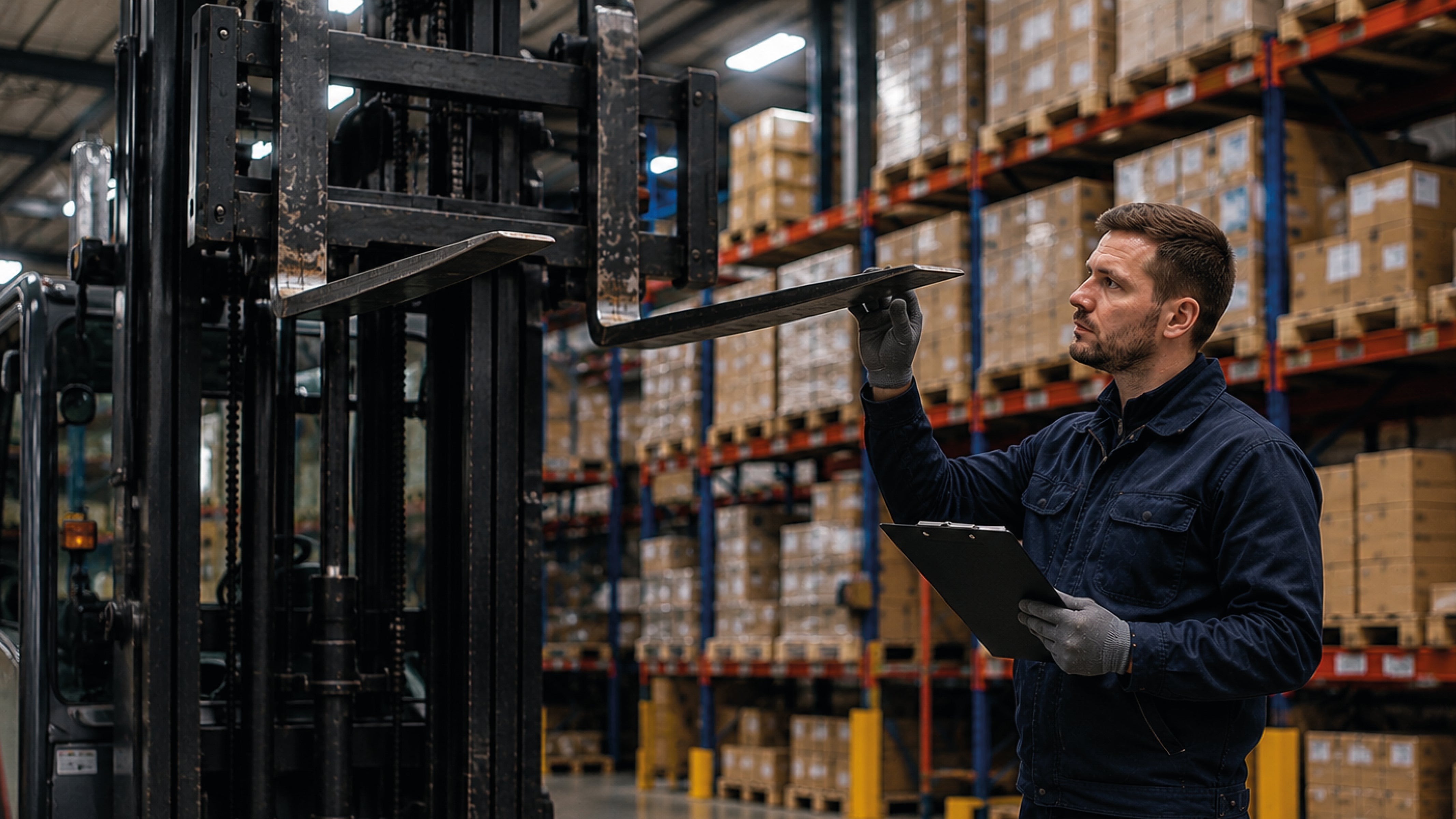
Checking Forklift Forks Correctly: Identifying Wear and Damage
Forks are central safety elements of industrial trucks. They transport heavy and valuable loads daily – often under demanding operating conditions. It is therefore all the more important to regularly check the condition of the forks and to detect wear and damage early on.
Why is fork inspection so important?
Damage to forks can have serious consequences. Typical defects include fractures in the fork blade, cracks in the fork heel, or damage to the welds of the fork hooks. Even fine hairline cracks can significantly impair stability and pose a safety risk.
Causes of wear and damage
Many damages are caused by improper use. Common causes include:
- Overloading of the forks
- Lifting loads with only one fork
- Subsequent manipulations such as welding or drilling
- Failure to comply with inspection intervals
- Material fatigue due to high load changes
These factors gradually lead to wear that goes unnoticed without regular inspection.
Legal requirements and inspection intervals
Fork inspections are clearly regulated. Relevant standards include ISO 5057, DGUV Regulation 68, and provisions from the Occupational Health and Safety Act.
Here are the most important inspection intervals:
- At least once a year
- After no more than 1,500 operating hours
- More frequently with intensive use
- Regular visual inspection
The annual inspection may only be carried out by qualified persons. Repairs are also only permitted by authorized specialists or the manufacturer.
Detecting and evaluating wear
A central inspection point is the material wear of the forks. Even with wear of more than 10% of the original fork thickness, the load capacity decreases by approximately 20%. If this limit is exceeded, the forks must be replaced.
Typical inspection criteria at a glance
- Surface cracks
Areas such as the inner bend between the fork blade and the fork heel are particularly critical. Most cracks are hardly visible to the naked eye, which is why magnetic particle and dye penetrant testing are used in practice. - Height differences of the fork tips
The height difference may not exceed 1.5% of the blade length. Larger deviations impair safe load handling. - Bending of the fork blade
Deformations often occur due to overloading. Depending on the extent, a straightening correction may be made or a replacement may be required. - Angularity
Forks are manufactured with an angle of 90°. Deviations arise from incorrect use and can lead to error-prone loading processes. - Arrestments
Functioning arrestments prevent the forks from slipping on the fork carriage. Damaged or missing components make operation impermissible. - Fork tips and fork hooks
Worn tips increase the risk of damage and accidents. Bends in the hooks impair stability and require measures up to replacement.
Conclusion
A systematic inspection creates the basis for greater safety and efficiency in everyday work.
Regular inspection of forks is a crucial component of safe industrial truck operation. Wear, cracks, or deformations must be regularly assessed and evaluated.
Adhering to the prescribed inspection intervals and consistently repairing damage not only reduces the risk of accidents but also ensures the long-term economic use of forklifts.
What if the fork is worn out?
At CleverForks, you can get both standard ISO forks and forks with additional functions such as extensions or anti-slip coating. Feel free to take a look.


Leave a comment
This site is protected by hCaptcha and the hCaptcha Privacy Policy and Terms of Service apply.